
A historic house (building) generally meets several criteria before being listed by an official body as "historic". Generally the building is at least a certain age, depending on the rules for the individual list. A second factor is that the building be in recognizably the same form as when it became historic. Third is a requirement that either an event of historical importance happened at the site, or that a person of historical significance was associated with the site, or that the building itself is important for its architecture or interior.
Historic buildings
-
 1
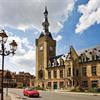
1City Hall and Belfry, Bailleul
In 2005 the Belfry at the heart of Ballieul was recognised by Unesco as being one of the most important historic monuments in the region. City Hall and Belfry, Bailleul.
-
 10
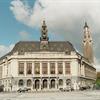
10City Hall and Belfry, Charleroi
The City Hall with a circumference of 240 meters is a stately and impressive building and was inaugurated on 18 October 1936. It was designed by architect Joseph Andre. Three heavy bronze doors give access to a hall of honour covered with marble.
-
 1
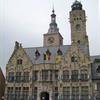
1City Hall and Belfry, Diksmuide
The City Hall and the Belfry with it's tower dominate the central market square of Diksmuide. Both were destroyed during the first world war and for the reconstruction the architects Jos. Vierin and Valentin Vaerwyck chose for new buildings in traditional flemish renaissance style.
-
 1
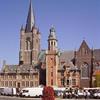
1City Hall and Belfry, Eeklo
The red-brick city hall, is a mixture of 17th century Flemish Renaissance architecture and modern renovations. One of the later additions (1930-32) is the belfry tower, which houses the town bells formerly kept in the adjacent church.
-
 1
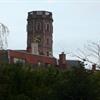
1City Hall and Belfry, Menen
The belfry of Menen has had a turbulent history which the building still bears witness to. In 1999 it was listed as a UNESCO world heritage Site.
-
 1
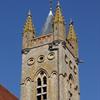
1City Hall and Belfry, Nieuwpoort
The building has a 35m-high sandy-coloured belfry. The complex together with other Flemish belfries have been listed as a UNESCO World Heritage Site in 1999.
-
 2
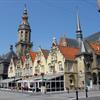
2City Hall and Belfry, Veurne
Several Renaissance-style buildings, mostly built using the local light-coloured brick, adorn Veurne’s central market square, which make it one of Belgium's finest market squares. Among these are the city hall (Landhuis) and belfry, which is recognized by UNESCO as World Heritage Sites in 1999.
-
 10
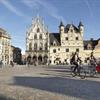
10City Hall, Mechelen
The Lakenhal (a cloth hall) and the 14th-century Belfry (UNESCO World Heritage ID 943-015) beside it, form now the City Hall on the main square.
-
 10
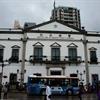
10Civic and Municipal Affairs Bureau, Macau
The councils and assemblies of the municipalities of Macau were abolished on 1 January 2002, and their functions transferred to the Instituto para os Assuntos Civicos e Municipais, slightly more than 2 years after Macau became a special administrative region of the People's Republic of China.
-
 2
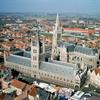
2Cloth Hall with Belfry, Ypres
The imposing Cloth Hall was originally built in the 13th century and was one of the largest commercial buildings of the Middle Ages. Cloth Hall with Belfry, Ypres.
-
 10
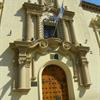
10Colegio Nacional de Monserrat
Colegio Nacional de Monserrat is a public college preparatory high school in Cordoba, Argentina. Patterened after the European gymnasium, the school is the second oldest of its type and one of the most prestigious in Argentina.
-
 10
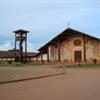
10Concepcion
The fourth mission in the World Heritage Site, the mission of Concepcion, was initially founded in 1699 by the Jesuit priests Fr. Francisco Lucas Caballero and Fr. Francisco Hervas.
-
 10
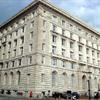
10Cunard Building, Liverpool
The Cunard Building is a Grade II listed building located in Liverpool, England. It is sited at the Pier Head and along with the neighbouring Liver Building and Port of Liverpool Building is one of Liverpool's Three Graces, which line the city's waterfront. It is also part of Liverpool's UNESCO designated World Heritage Maritime Mercantile City.
-
 9
9Diwan-i-Am, Red Fort
The Diwan-i-Am, or Hall of Audience, located in the Red Fort of Delhi was where the Mughal emperor Shah Jahan (1628-1658) and his successors received members of the general public and heard their grievances.
-
 10
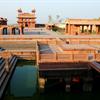
10Fatehpur Sikri
Fatehpur Sikri is a city in the Agra District of Uttar Pradesh, India. Previously the city's name was Vijaypur Sikari, of the Sikarwar Rajput clan, the later city was founded in 1569 by the Emperor Akbar, and served as the capital of the Mughal Empire from 1571 to 1585.
-
 10
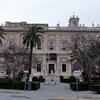
10General Archive of the Indies
The Archivo General de Indias, housed in the ancient merchants' exchange of Seville, Spain, the Casa Lonja de Mercaderes, is the repository of extremely valuable archival documents illustrating the history of the Spanish Empire in the Americas and the Philippines.
-
 10
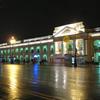
10Great Gostiny Dvor
Great Gostiny Dvor is a vast department store on Nevsky Avenue in St Petersburg. This Gostiny Dvor is not only the city's oldest shopping centre, but also one of the first shopping arcades in the world.
-
 9
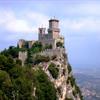
9Guaita Tower
The Guaita is the oldest of the three towers, and the most famous. It was constructed in the 11th century and served briefly as a prison.
-
 1
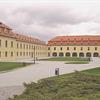
1Hillebrandt building, Bratislava Castle
To the west of the main building, is the newly reconstructed Hillebrandt building which dates from 1762 and was destroyed by the 1811 fire. The Yard of Honor is the space directly before the castle entrance dates from the late 18th century.
-
 10
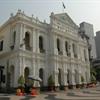
10Holy House of Mercy, Macau
The Holy House of Mercy of Macau, is a historic white building in Senado Square, Macau, China. Established as a branch of the Santa Casa da Misericórdia, it was built in 1569 on the orders of the Bishop of Macao.
-
 10
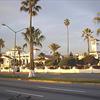
10Hotel Riviera del Pacifico, Ensenada
The Hotel Riviera del Pacifico was a hotel located in Ensenada, Baja California, Mexico. It was one of the most prestigious and luxurious hotels in Mexico, and the place of birth of the Margarita cocktail.
-
 10
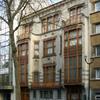
10Hotel Solvay
The Hotel Solvay is a large Art Nouveau town house designed by Victor Horta on the Avenue Louise in Brussels. The house was commissioned by Armand Solvay, the son of the wealthy Belgian chemist and industrialist Ernest Solvay.
-
 10
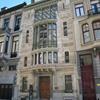
10Hotel Tassel
The Hotel Tassel is a town house built by Victor Horta in Brussels for the Belgian scientist and professor Emile Tassel in 1893–1894. It is generally considered as the first true Art Nouveau building, because of its highly innovative plan and its groundbreaking use of materials and decoration.
-
 1
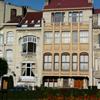
1Hotel van Eetvelde
The Hotel van Eetvelde is a town house designed in 1895 by Victor Horta for Edmond van Eetvelde, administrator of Congo Free State. Together with the Hotel Tassel, the Hotel Solvay and his own House and atelier it was put on the 'UNESCO World Heritage List' in 2000 as the core of epoch-making urban residences Victor Horta designed before 1900.
-
 10
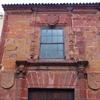
10House of Corregidores
This building from 1540 is one of the oldest in the city, though all that remains of the original construction is the entrance made of red volcanic rock.